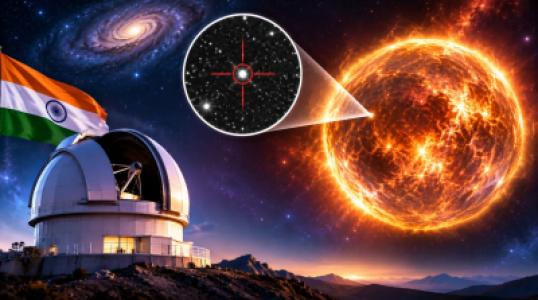
Astronomers have spotted a rare, young Type Ia supernova, named SN 2026ahvu, lighting up the spiral galaxy NGC 1433 about 50 million light years away. First picked up by the ATLAS sky survey in early November 2026, this cosmic blast is one of the closest Type Ia explosions seen since 2011. What makes it extra special is how early it was caught by scientists and it was rapidly brightening before their eyes, giving them a rare front-row seat to a star's dramatic final act.
A Type Ia supernova happens when a white dwarf burns out from core of a star much like our Sun pulls too much gas from a nearby companion star and triggers a massive nuclear blast. Because these explosions reach a fairly steady peak brightness, astronomers use them as cosmic measuring tapes which are often called "standard candles" , to measure how far away galaxies are and how fast our universe is expanding. Catching SN 2026ahvu so early lets telescopes around the world track its light before it fades, turning a routine sky scan into a major space discovery.