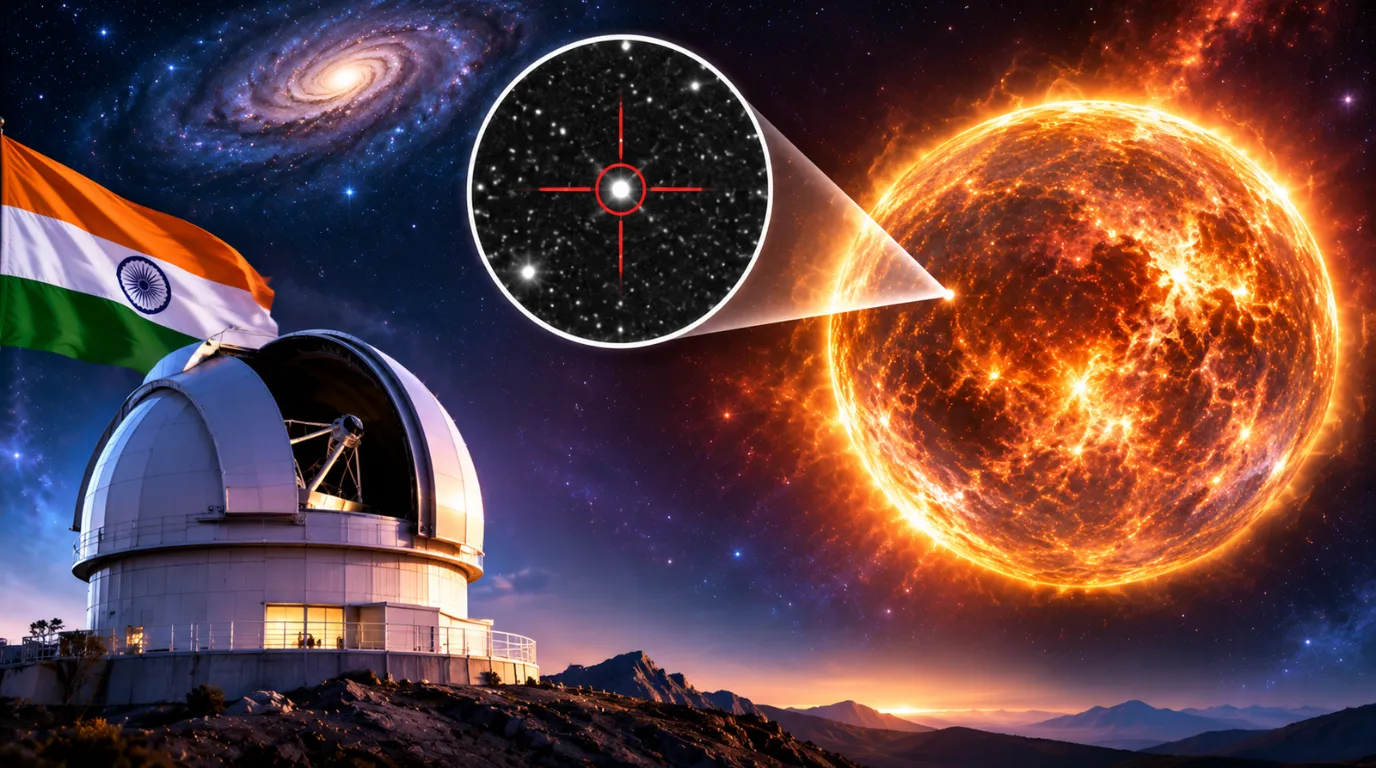
In a major space breakthrough, Indian astronomers have discovered an ultra rare ancient star that acts like a cosmic time capsule from the early universe. Scientists from the Indian Institute of Astrophysics (IIA) in Bengaluru and Dakshin Kamrup College in Assam identified this stellar fossil, officially named HE 1153 0518.
Using powerful data from the Subaru Telescope in Hawaii, the research team studied the star's light and chemical makeup. Their findings reveal that this ancient star preserves vital chemical clues about the very first generations of stars that lit up the cosmos more than 13 billion years ago, shortly after the Big Bang. What makes HE 1153-0518 truly extraordinary is its unusual chemistry. Unlike our Sun, which is rich in metals, this ancient relic has only about one thousandth of the Sun iron content. However, it is surprisingly packed with high amounts of carbon and sodium, while lacking heavier elements. Because it formed from the gas left behind by the universe earliest exploding stars, its chemical fingerprint remains untouched.
Published in the Monthly Notices of the Royal Astronomical Society, this discovery helps scientists understand how the earliest stars created the basic building blocks for future planets, galaxies, and life itself. For Indian space science, finding this rare cosmic fossil marks a proud step forward in unlocking the deepest mysteries of our Milky Way birth.