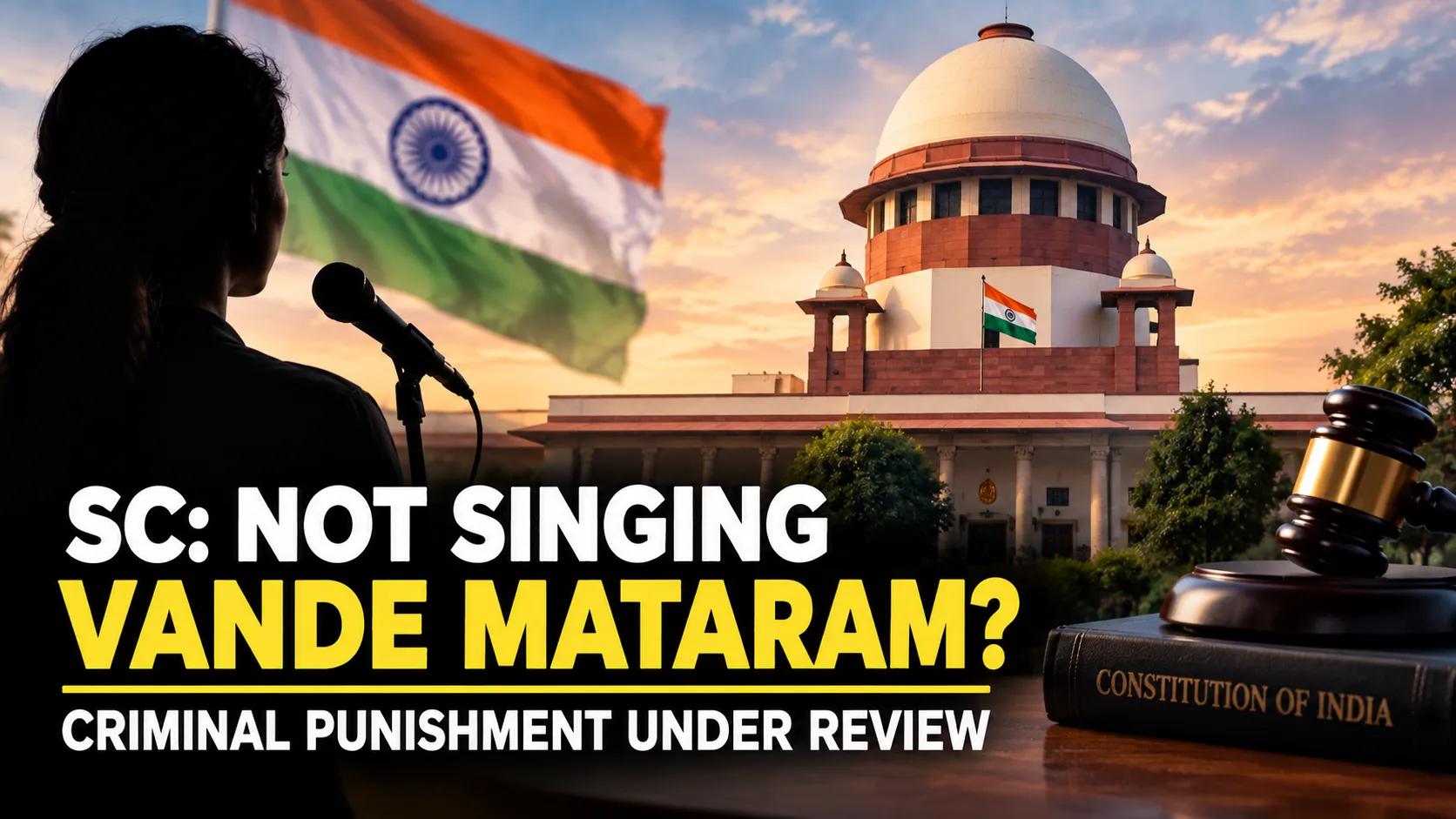
The Supreme Court has indicated that a person who has a genuine religious or conscientious objection to singing Vande Mataram should not face criminal punishment. The observation came during the hearing of a petition filed by Carnatic vocalist T M Krishna, who has challenged the government direction requiring all six stanzas of the national song to be sung at official events.
A three judge bench headed by Chief Justice Surya Kant, along with Justices Joymalya Bagchi and V Mohana, said the issue of criminal punishment should be examined in the light of fundamental rights, including freedom of conscience and religion under Articles 25 and 26 of the Constitution.
The court also referred to its 1986 Bijoe Emmanuel judgment. In that case, the Supreme Court had protected school children who respectfully refused to sing the national anthem because of their personal beliefs. The court said this earlier legal principle has not been challenged and should be kept in mind while considering the present matter.
Krishna petition challenges the legal provisions and government directions concerning the complete six stanzas of Vande Mataram. He has raised concerns about the religious references in the later stanzas and their impact on freedom of conscience. The Centre has been asked to respond. The Supreme Court has not decided whether Vande Mataram should have two or six stanzas, saying that question is for Parliament to consider.