
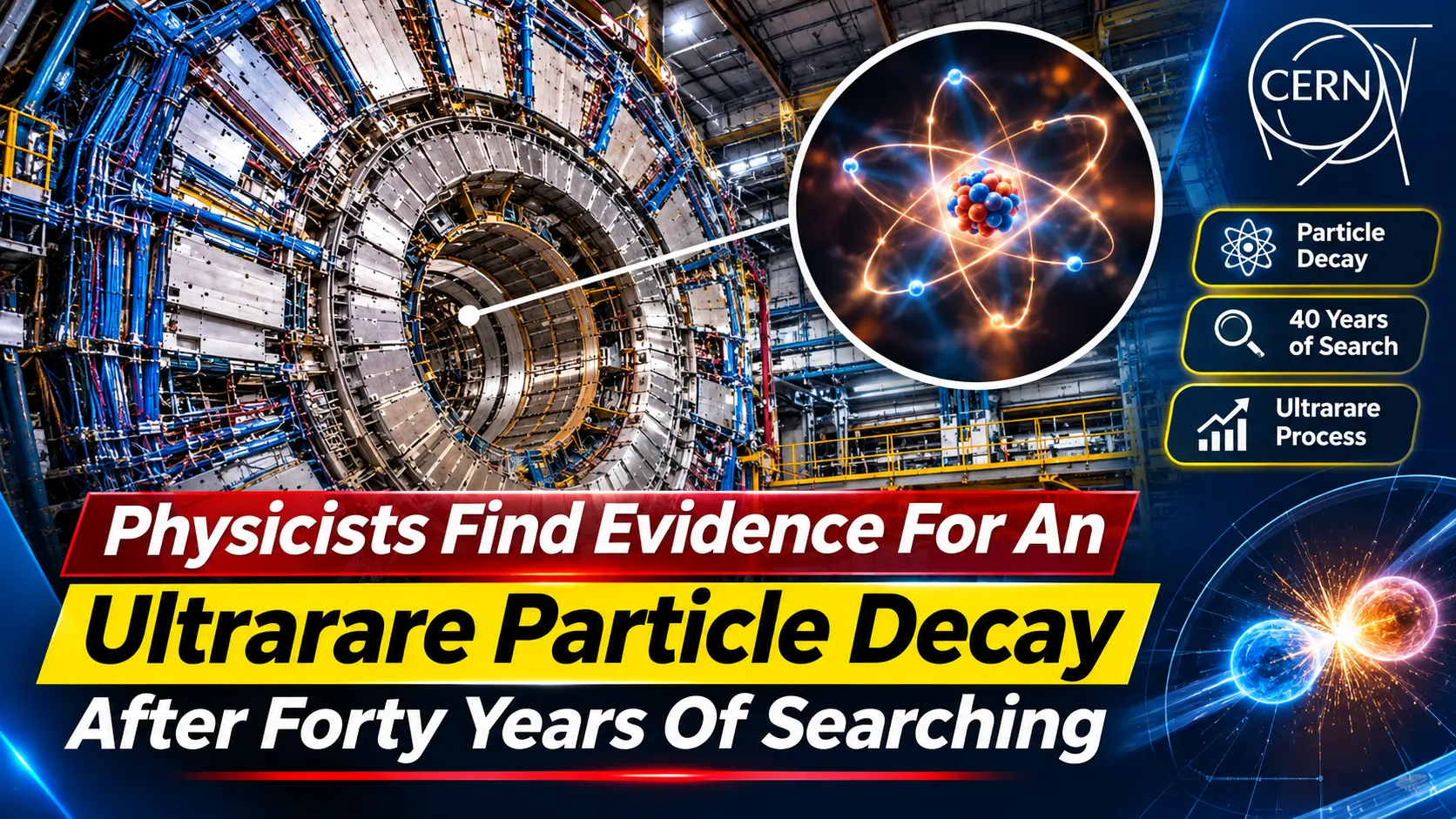
In a groundbreaking scientific milestone, physicists working at CERN Large Hadron Collider in Europe have found the first evidence of an extremely rare particle decay. The historic discovery comes after more than four decades of intense searching by global science teams.
The experiment focused on short lived beauty particles, which are heavy microscopic building blocks created during high energy particle collisions. These particles exist for only a fraction of a second before breaking down into smaller subatomic particles. Researchers recorded evidence of a special decay known as Bd to mu mu, where a beauty particle transforms directly into two heavier electron like particles called muons.
According to theoretical predictions, this specific decay process happens only once in every ten billion beauty particles, making it extraordinarily difficult to detect. To spot this rare event, scientists used advanced artificial intelligence and upgraded high speed silicon detectors that record billions of subatomic collisions.
This scientific breakthrough offers fresh insights into fundamental forces and helps test current laws of physics. Experts believe exploring these ultra rare decays could eventually reveal mysterious hidden secrets of the universe, such as dark matter and previously unknown natural forces.