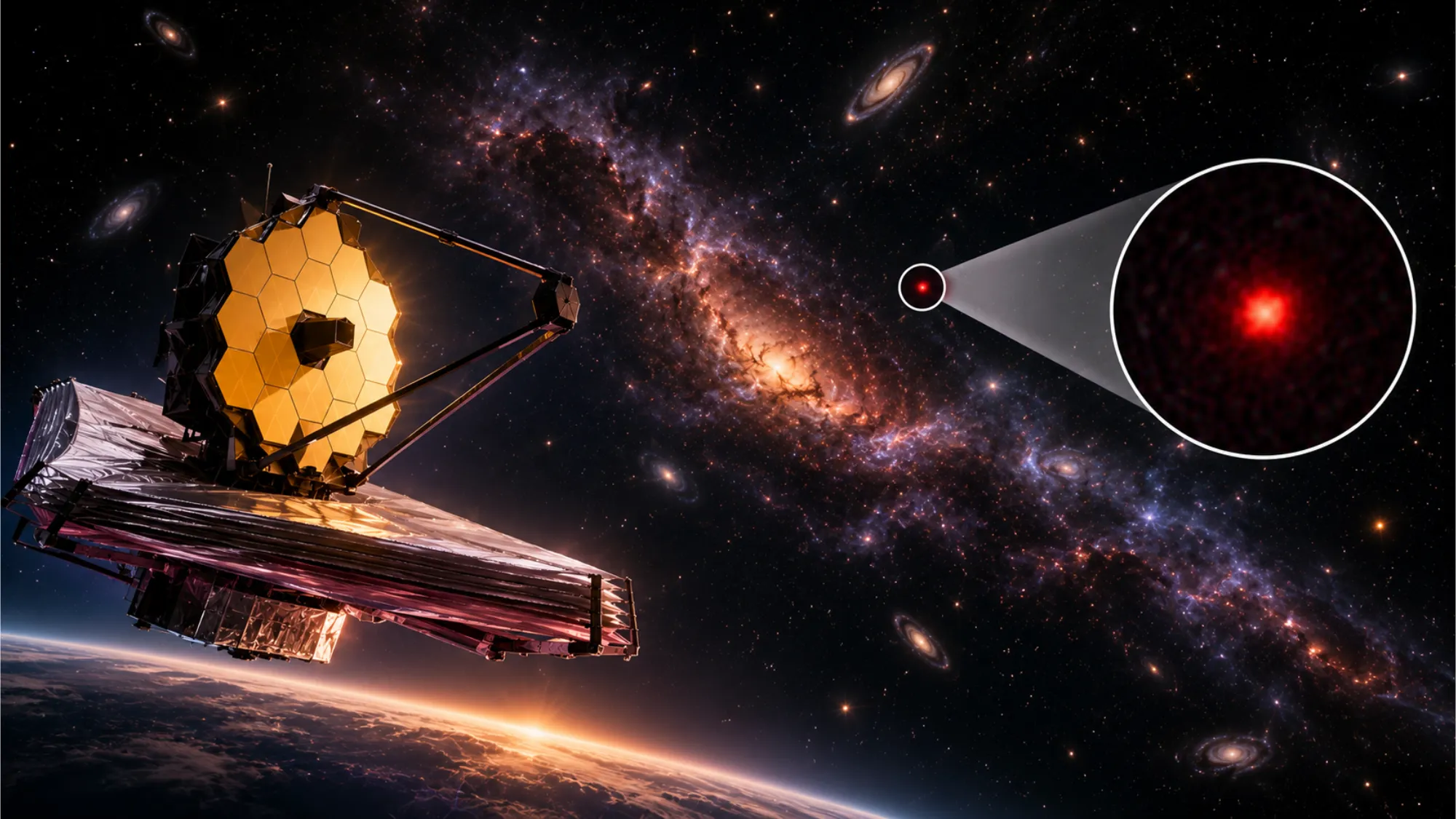
In a major space breakthrough, astronomers using NASA James Webb Space Telescope have confirmed the distance to the oldest and farthest little red dot candidate ever seen in our universe. Named CW LRD z10, this tiny, bright red object existed just 450 million years after the Big Bang when the universe was still very young.
An international team of scientists led by Takumi Tanaka published these exciting findings in The Astrophysical Journal Letters. Using the telescopes powerful infrared cameras and light splitting tools, researchers measured the exact distance of CW LRD z10, finding a high redshift of 10.36.
Little red dots are one of the biggest mysteries in modern space science. Scientists believe these small, compact objects could be early galaxies hiding supermassive black holes wrapped in thick clouds of gas and dust. Finding one so early in cosmic history gives astronomers a rare window into how the very first giant black holes and galaxies were born. Next, scientists plan to study the hydrogen gas around CW LRD z10 to confirm if a growing black hole is truly hiding inside. This discovery proves once again how the James Webb telescope is helping us look back in time and unlock the deepest secrets of our universe beginning.