
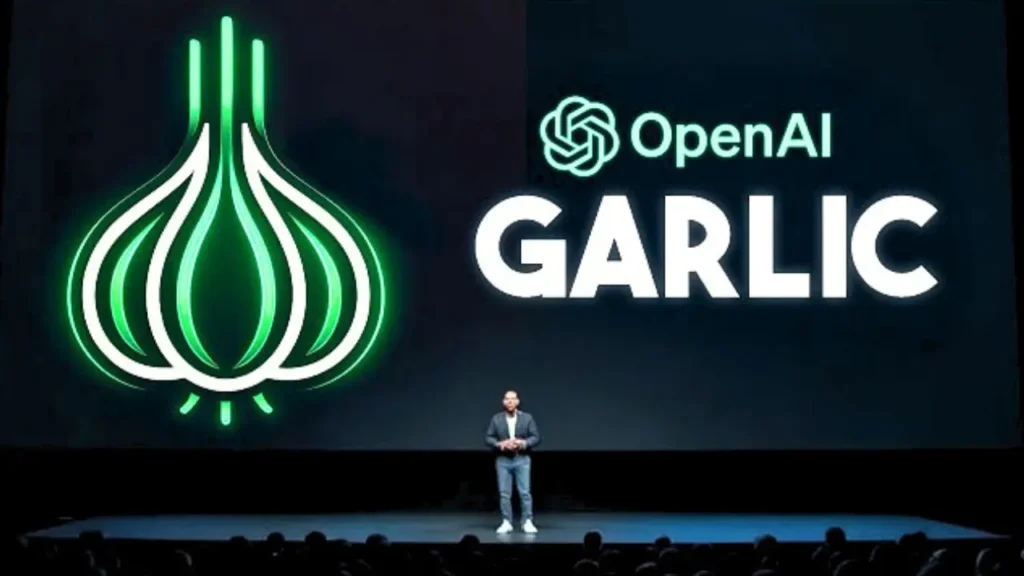
OpenAI is quietly preparing what insiders call its next big leap in artificial intelligence, a model codenamed Garlic. This project has created a wave of curiosity across the tech world, not only because of its mysterious name. But because of what it aims to achieve. Garlic is rumored to push the limits of coding, reasoning, and learning efficiency, challenging giants like Google Gemini 3 and Anthropic Opus 4.5. OpenAI Garlic is believed to build upon an earlier experimental model named Shallotpeat. While that project focused on improving training efficiency, OpenAI Garlic reportedly takes things several steps further. It explores how large-scale models can retain high performance while using fewer computational resources. In simpler terms, OpenAI wants Garlic to think faster, cost less, and still reason as deeply as the biggest models available today.
Insiders suggest that Garlic outperforms competitors in areas that matter most to developers and researchers. Experts say coding assistance, multi-step reasoning, and adaptive learning rank among its strongest suits. If true, this would give OpenAI a major advantage in a space where speed, accuracy, and reliability often come with heavy computational costs. Garlic architecture appears to focus on compressing large-model intelligence into a smaller, more efficient system. Making it suitable for a wider range of applications, including local AI integrations and enterprise systems.
Another striking detail is OpenAI shift toward what experts describe as efficient pre-training. Instead of endlessly scaling model size, the company appears to optimize how it processes data during training. This could lower expenses while maintaining high-quality outputs. Allowing future AI systems to reach more users and devices without massive infrastructure demands. It also signals a possible move toward greener AI development, reducing the energy footprint associated with large-scale model training.
Though OpenAI has not made any public announcement, speculation points to a potential launch in early 2026. Garlic might appear under an official version name such as GPT 5.2 or GPT 5.5. Depending on how OpenAI decides to brand it. Sources close to the company indicate that competition has accelerated internal timelines, as Google and Anthropic continue releasing improved versions of their own models.
The secrecy around Garlic has fueled both excitement and skepticism. Without verified benchmarks or peer-reviewed results, claims about its superior performance remain unconfirmed. Still, the idea of a smarter, faster, and lighter model has generated significant anticipation among developers who want practical AI that balances power with affordability. If Garlic achieves what OpenAI envisions, it could redefine the economics of artificial intelligence. Instead of focusing only on size and scale, AI development might shift toward precision, adaptability, and efficiency. For now, the tech community waits to see if Garlic will truly set a new benchmark or remain another ambitious experiment in OpenAI evolving lineup of models.