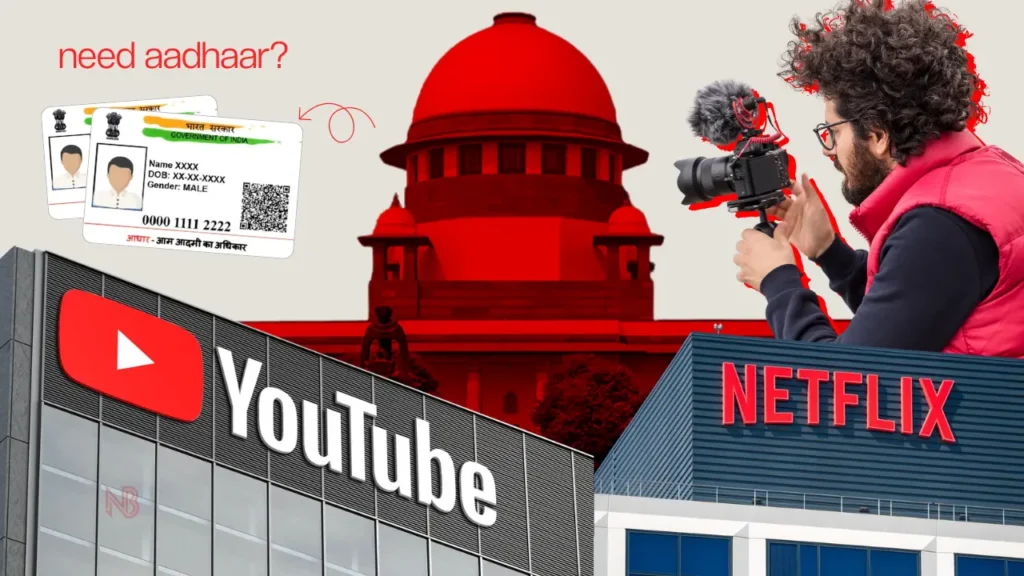
The Supreme Court of India has proposed requiring age verification possibly using Aadhaar (or PAN) before users can access. Content deemed “obscene” sensitive or potentially harmful on streaming platforms such as Netflix, YouTube and other OTT/social-media services. The suggestion came during a broader hearing on online content regulation not as a final ruling, but as a possible way forward. Before you watch certain web shows or videos. Patforms may ask for identity-proof and confirm your age rather than relying solely on self-declared age or blanket warnings. The push for Aadhaar-based age checks emerged in the context of a case triggered by alleged obscene and insensitive content in an episode of the online show India’s Got Latent. Police filed FIRs against the creators for making comments that mocked persons with disabilities and included “adult” jokes and themes.
During the hearing, the Court bench Surya Kant (Chief Justice) and Joymalya Bagchi remarked that current practices are inadequate. A short warning screen or disclaimer often shows up just before a stream start. But by the time a viewer decides not to proceed, the show might already have begun playing. That undermines the purpose of the warning. To address this, the Court floated the idea of age-gating: a short warning, followed by a prompt for Aadhaar/PAN verification. Only after confirmed adult age, the content would begin. This, the Court suggested, could operate as a pilot. Beyond age checks, the Court also stressed the need for an independent regulator not self-regulating industry bodies, which it called insufficient to oversee digital content, particularly user-generated content.
The suggestion limits regulation to content the Court deems “obscene” or potentially harmful, such as material that mocks persons with disabilities or promotes “anti-national” or inflammatory ideas. It does not amount to a binding order. The Court has asked the government to draft a regulatory framework, open for public consultation in coming weeks. Platforms are free to continue showing age-warnings or use existing self-regulatory rules, unless or until new rules are adopted. If implemented, Aadhaar-based age verification could reshape the way Indians consume digital content. For one, it could reduce minors’ access to adult material. Privacy and anonymity Aadhaar is a government-issued identity document, and linking it to media consumption raises questions around data protection, surveillance, and digital freedom. Under a 2018 ruling, the Court had struck down mandatory Aadhaar linking for private services beyond welfare and tax purposes.
Creative freedom strong regulation might curb some forms of content expression. Many voices caution that such measures could undermine free speech, especially where “obscenity” or “anti-national” labels are loosely defined. The Court itself signaled sensitivity to that risk while suggesting the regulatory shift. Regulatory implementation a lot depends on how the government drafts the framework, and whether age-verification is rolled out as a pilot or full-blown mandate.
The Court has asked the central government to present a draft of the regulatory framework within four weeks, followed by public consultation. If approved, new rules could oblige platforms to introduce Aadhaar/PAN-based age checks (or alternative verified age checks). Before playing adult content, along with clear warnings and parental-control or user-control features. The move shows the Court concern about unchecked content flowing freely to every home. Instead of relying on voluntary compliance or disclaimers, it wants a stronger, more enforceable mechanism to protect minors and vulnerable viewers. If it becomes law, we might see a new age-verification barrier before certain Netflix/YouTube shows and a fundamental shift in how OTT platforms handle adult content in India.