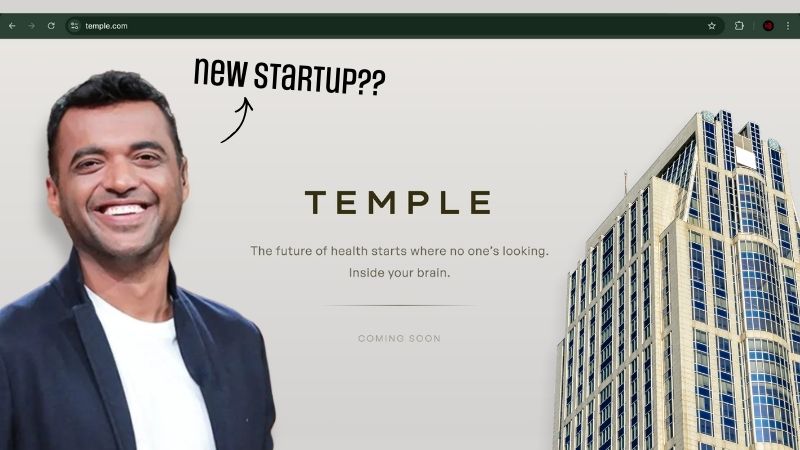
Deepinder Goyal, founder of Eternal (parent of Zomato and others), is reportedly weighing a new venture: a wearable-device company named Temple. The plan: build head-worn sensors tracking cerebral blood flow a novel metric in the health-tech world. Sources say talks are in early stages; nothing is set in stone. Temple website features only a “Coming Soon” notice, along with the line “The future of health starts where no one’s looking. Inside your brain.” No launch date appears.
Interest surged after Deepinder Goyal posted photos from a public event organised by Eternal nonprofit Feeding India. In one image, he’s standing next to Albinder Dhindsa, wearing a small device on the right side of his face near the temple region. Social media buzzed with questions: what is this device? Days later, his research initiative Continue Research publicly introduced the Gravity Ageing Hypothesis. The hypothesis suggests gravity, acting over years on blood circulation, might gradually reduce blood supply to the brain. That drop could impair vital brain functions over time, accelerating ageing.
Deepinder Goyal clarified that the device he wore is an experimental brain-flow monitor something he has reportedly used for over a year to track real-time cerebral blood flow. Its aim is to validate the Gravity Ageing Hypothesis with actual data. He posited that even if the hypothesis proves wrong, brain-flow remains a widely recognised biomarker linked to ageing, cognition, and longevity.
Continue Research claims upright posture and gravity can lead to a drop in cerebral blood flow (CBF) by up to 17 percent. Their early findings reportedly show that passive inversions, where the head is lower than the heart, such as on inversion tables might reverse this drop and increase brain flow. According to Deepinder Goyal, six weeks of daily inversion therapy showed a roughly 7 percent increase in average daily brain flow among his team. However, the idea has drawn skepticism from medical experts and commentators. Critics argue the Gravity Ageing Hypothesis remains untested and lacks peer-reviewed backing. Many view the current claims as speculative rather than science-based.
If Temple moves ahead, it could mark an early attempt in India to commercialise head-worn brain-flow monitoring technology. For now, the project remains tentative. The venture success would depend on rigorous scientific validation, regulatory clearances, and user acceptance of a device strapped to one’s temple. Deepinder Goyal is trying to push longevity research from theory into a tangible device. Whether Temple becomes a breakthrough or just another ambitious experiment depends on whether blood-flow tracking can stand up to real-world science.